

Aerial yoga is yoga done in a silk hammock hung from the ceiling, so you can stretch, take your weight off the floor or hang upside down. Studios advertise a long list of benefits, but the research behind them is small. The main study followed 16 healthy women for six weeks, and one small trial in student athletes adds to it. What they suggest is a moderate workout that may help fitness, flexibility and balance, with some risks that matter for people with certain health conditions.
What Aerial Yoga Involves
Instead of a mat, you use a hammock suspended from a frame or ceiling mount. The Pfizer health page describes aerial yoga as traditional yoga combined with elements of aerial arts. A class at YogaOne in Abu Dhabi, described in The National, began with light stretches such as a crescent lunge with one leg across the swing, moved on to a downward dog over the swing and a basic inversion known as the inverted butterfly, and ended with a resting pose in the hammock. The instructor adjusts the hammock length and tension for each person before class, according to Abu Dhabi Confidential.
Benefits That Have Some Support
Fitness and calorie use
In a study sponsored by the American Council on Exercise, 16 healthy, physically active women aged 18 to 45 attended three 50-minute aerial yoga classes a week for six weeks. Classes averaged 320 kilocalories each and were rated moderate-intensity exercise. By the end, the women showed improvements in weight, body fat percentage, waist circumference, aerobic fitness (VO2max), systolic blood pressure and HDL cholesterol, according to the ACE report. The study was small, involved only healthy women, used one instructor and, as the report describes it, had no control group, so it cannot show that aerial yoga caused the changes or that the same results would follow in other people. For a broader perspective on healthy exercise habits, read about how nutrition and physical activity work together.
Flexibility and balance
A small exploratory study assigned 60 student athletes aged 18 to 25 at random to an eight-week aerial yoga programme, with three 60-minute sessions a week, or to no programme. The authors report significant improvements in flexibility and balance in the aerial yoga group. The abstract gives no figures, so the size of the effect is unclear, and the study is described as exploratory.
Stress and mood
None of the aerial yoga studies above measured stress or mood, so this benefit rests on research into yoga in general. The National Center for Complementary and Integrative Health (NCCIH) reports that, of 17 studies it reviewed, 12 showed improvements in physical or psychological measures related to stress, and calls the evidence promising rather than proven. It adds that yoga has not been shown to help manage diagnosed mental health conditions, so it should not replace treatment from a doctor or therapist. See the NCCIH overview.
Back pain
The evidence again concerns yoga in general, not aerial yoga. NCCIH’s summary says guidelines from the American College of Physicians strongly recommend mind and body approaches including yoga for low back pain, but based on low-quality evidence, and that a Cochrane review found low-to-moderate certainty evidence of small improvements in pain and function that were not clinically important. Studios often explain that hanging upside down decompresses the spine. The aerial yoga studies above did not test that, so treat it as an explanation, not an established effect. If you have back pain, see a doctor before starting. NCCIH’s evidence summary sets out the research. For practical information beyond yoga classes, see our guide to managing work-from-home back pain.
Claims to Treat with Caution
Claims that aerial yoga increases lung capacity, boosts oxygen to the brain, relieves joint pain or guarantees weight loss were not tested in the studies above. A class that burns about 320 kilocalories is a moderate workout, and results will depend on how often you go and what else you do. Take any promise of a cure or quick transformation with scepticism.
Who Should Be Careful
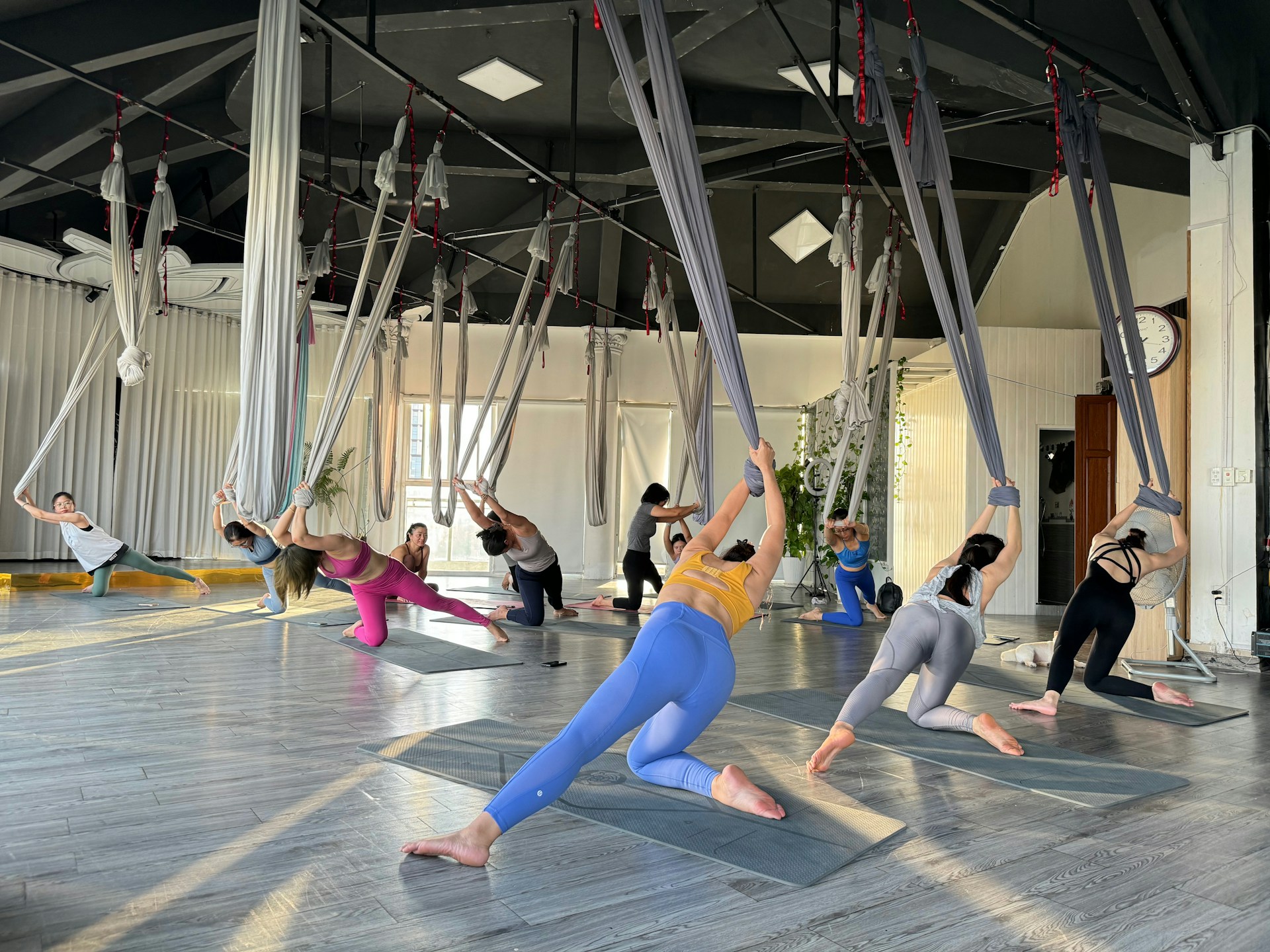
Photo by Mandy Doan on Unsplash
NCCIH says yoga is generally safe for healthy people when done properly with a qualified instructor, that the most common injuries are sprains and strains, and that serious injuries are rare. Pregnant women, older adults and people with health conditions may need to avoid or modify some poses. Aerial yoga adds the hammock and inversions, and the Pfizer page says it may carry more safety risks than mat-based yoga and requires strength and proper technique to avoid injury. People with an existing bone, joint or spine problem may wish to discuss suitable exercise with a clinician; our directory of orthopedic doctors in Abu Dhabi may help when looking for a specialist.
- Eye conditions. Glaucoma Australia summarises a study in which healthy people and people with glaucoma both had higher eye pressure in four head-down yoga positions, with downward facing dog giving the largest rise, and notes that earlier research found that a headstand roughly doubled eye pressure. It advises people with glaucoma to speak to their eye specialist and tell the instructor. See Glaucoma Australia’s summary. A studio quoted in the ACE report also advises against aerial yoga for people with cataracts.
- High blood pressure and heart conditions. Pfizer lists blood pressure problems and heart conditions among the situations where you should speak to a healthcare professional first, and the studio quoted by ACE does not recommend it for high blood pressure.
- Pregnancy. Pfizer and NCCIH both advise speaking to a healthcare provider first, and the studio quoted by ACE does not recommend aerial yoga in pregnancy.
- Neck and shoulder problems. Pfizer advises avoiding excessive pressure on the neck and shoulders during poses, and recommends a certified instructor and beginner classes to start.
How to Choose a Class and an Instructor
- Ask about the instructor’s certification. Pfizer advises always practising aerial yoga under a certified instructor.
- Start with a beginner or fundamentals class. At YogaOne, a fundamentals class where the instructor explains the poses using the hammock runs at a slower pace, according to Abu Dhabi Confidential.
- Look for small classes. The same article says the YogaOne room holds eight hammocks, so space is limited and early booking is needed.
- Tell the instructor about your health. Mention any eye, blood pressure, heart, neck, shoulder or back problems, and pregnancy, before class.
- Expect the hammock to be adjusted for you. Check that the instructor sets the length and tension before you start, and ask to come out of an inversion if you feel unwell.
If you also train outdoors during the UAE’s hot months, our guide to common summer workout mistakes to avoid offers additional seasonal exercise tips.
Where to Try Aerial Yoga in Abu Dhabi
YogaOne is the Abu Dhabi studio that could be confirmed as offering aerial yoga, which it runs as anti-gravity yoga with silk hammocks. Classes have been described for adults and, in one report, children from age six.
| Detail | Information |
|---|---|
| Studio | YogaOne, Abu Dhabi |
| Class | Aerial (anti-gravity) yoga in silk hammocks, with a fundamentals class for beginners |
| Location | YogaOne – Zone 1 – Abu Dhabi – United Arab Emirates |
| Website | yogaone.ae |
| Phone | +971 50 950 8863 |
Class schedules, prices and locations change, so check with the studio before booking.
Frequently Asked Questions
Is aerial yoga good for back pain?
Research on yoga in general suggests small improvements in low back pain, but no aerial yoga study has shown that hanging in a hammock treats it. See a doctor first if you have back pain, and tell the instructor.
Can aerial yoga help with weight loss?
A class used about 320 kilocalories on average in one small study, and the women in it showed improvements in weight and body fat over six weeks. The study was small and had no control group described, so it does not show that aerial yoga alone leads to weight loss.
Is aerial yoga safe for beginners?
Beginners can start, ideally with a beginner or fundamentals class and a certified instructor. Pfizer notes that aerial yoga may carry more safety risks than mat-based yoga and needs proper technique, and NCCIH says the most common injuries in yoga are sprains and strains.
Who should not do aerial yoga?
Speak to a doctor first if you are pregnant or have a heart condition, high blood pressure, glaucoma, cataracts or other eye conditions, or neck and shoulder problems. Head-down positions raise eye pressure, according to the study summarised by Glaucoma Australia.
How is aerial yoga different from regular yoga?
Regular yoga is done on a mat. In aerial yoga a hammock supports part of your weight and allows inversions and hanging poses, which is why it needs a trained instructor and more attention to safety.
How often should I do aerial yoga?
The studies above used three classes a week, for six and eight weeks. They do not establish an ideal frequency, so start gently and ask your instructor how to build up.
Can I do aerial yoga if I am pregnant?
Speak to your doctor or midwife first. Pfizer and NCCIH both advise pregnant women to talk to a healthcare provider before aerial yoga or yoga generally, and the studio quoted in the ACE report does not recommend aerial yoga during pregnancy.
Does aerial yoga increase lung capacity or improve brain oxygen?
These claims are often made, but the aerial yoga studies above did not test them, so they should be treated as unproven.

Hugo F. Martineau is a medical student in Dubai, UAE. He loves to research and write content. When he’s not in the library or the lab, Hugo enjoys spending time with his friends and family. He also likes to play sports, especially basketball. Hugo is originally from Haiti, and he is grateful for every opportunity that he has been given.
